
Client Context
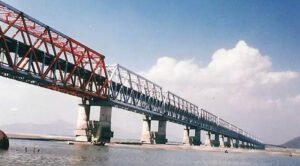
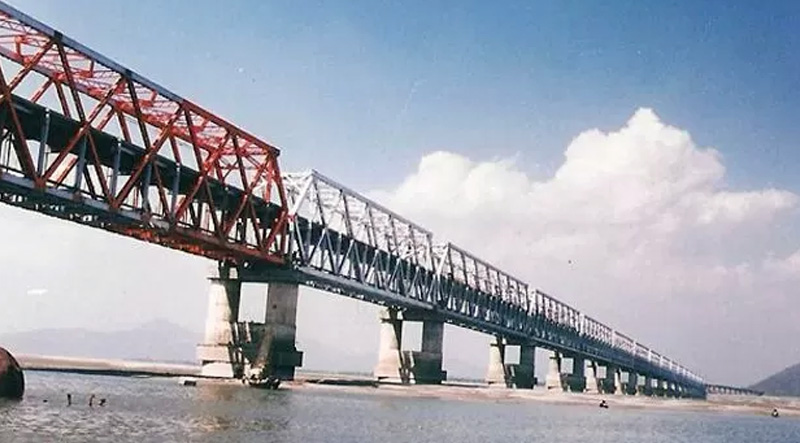
The project involved constructing a major rail bridge over the River Ganga in Bihar—one of the most challenging river systems in India due to deep alluvial soils, high water levels, and complex hydraulic behaviour.
During construction of Pier P3, a critical well curb weighing 365 MT was found to be misaligned by 1200 mm due to a mismatch between design coordinates and actual field conditions.
The designer proposed a large-scale rectification scheme with heavy equipment, extensive dismantling, and an estimated 2-month execution window at very high cost. The project was already under tight timelines, and any delay would impact subsequent well sinking, pier construction, and girder launching.
Challenges
- Massive 365 MT precast well curb already cast in position and embedded into initial ground layers.
- Required lateral shift of 1200 mm without disturbing structural integrity.
- No major cranes or heavy shifting equipment available at site due to monsoon logistics and remote location.
- The official design proposal involved high cost and long execution duration.
- Need for a safe, precise, rapid solution using minimal resources.
- Working over a live riverbed, with strict safety and quality control.
Our Approach
We focused on innovative, simplification, and controlled engineering, delivering a solution that eliminated the need for the large rectification scheme.
A. Engineering Preparation
- Excavated 6 pockets below the well curb to place built-up shifting girders (3 on each side).
- Created a solid base using:
- 300 mm boulder bed
- 150 mm PCC
- 570 mm built-up girders with a 25 mm top plate
- Welded guiding brackets on either sides to restrict lateral movement.
B. Reducing Friction & Load Resistance
- Manual excavation along the entire periphery of the well to free it for movement.
- Applied hot melted wax on girder surfaces to reduce friction during shifting.
C. Shifting Mechanism Using Hydraulic Jacking
- Used only 3 hydraulic jacks in initial cycles (100 MT capacity, 14 cm ram).
- Connected to a single manifold/power pack for uniform pressure control.
- Conducted 8 controlled jacking cycles, shifting the curb in steps of 50–150 mm per cycle.
- Continuous survey monitoring:
- Abutment 1 side: plate markings at 50 mm intervals
- Abutment 2 side: piston stroke measurements
- Realigned jacks and provided packing blocks after each cycle.
D. Workforce & Resources
- Total manpower: 23 persons only
- No cranes or heavy launchers used
- Entire operation completed safely with zero structural damage
Results
- The 365 MT well curb was shifted precisely by 1200 mm in just 7 days, against the designer’s 2-month estimate.
- Achieved using minimal resources: 3 hydraulic jacks, built-up girders, one power pack, and a small crew.
- Cost savings were enormous, avoiding heavy machinery mobilization and complex dismantling.
- Well sinking restarted immediately after correction, protecting overall project timelines.
- Demonstrated exceptional innovation, resourcefulness, field engineering expertise, and leadership.
- Appreciated by top management for delivering a feasible, economical, and technically sound solution under severe constraints.